Welch grid
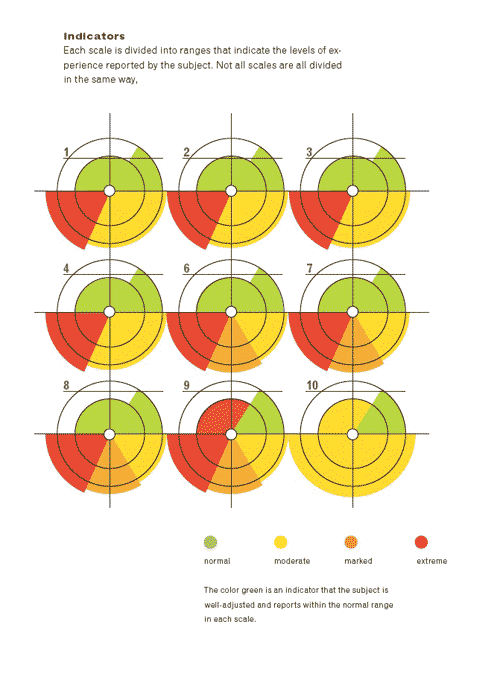
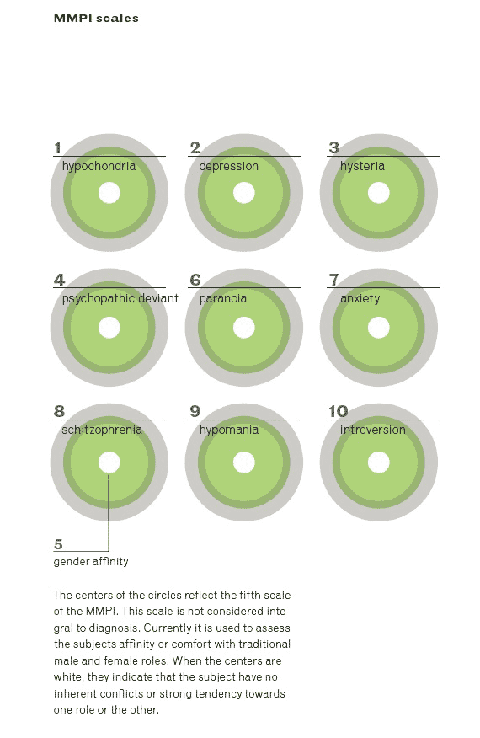
The Welch Grid is a data-driven symbol that is the visualized results of the Minnesota Multiplastic Personality Inventory test (MMPI), which is a test used for neuropsychological assessment. The symbol consists of a 3 x 3 grid that allocates each position to the scales measured in the MMPI. The scores of each scale inform the size, shape, color, and behavior of the forms that emerge. As a unit, the Welch Grid operates in providing a first level read of the scores that is lacking in the current visualization available. The Welch Grid also creates the opportunity for assessors to easily read multiple cases at a time.
The Minnesota Multiplastic Personality Inventory is a neuropsychological test used to assess mental health. The MMPI assists in evaluating personality and psychopathology. There are ten major areas that the test examines: hypochondria, depression, hysteria, psychopathology, gender affinity, paranoia, anxiety, schizophrenia, mania, and introversion. Also integral to the test is the validity scales that determine whether subjects have answered the questions consistently, randomly, are projecting themselves in a good or bad light, and if they are defensive.
The MMPI uses 567 items, all true or false and usually takes 1 to 2 hours to complete. Various subscales have been created to further break down the categories of answers for analysis. Like most standardized test, the MMPI is not representative of percentile rank or how ‘well’ a person perform. It uses ranges to determine if the subject is reporting normal, elevated, or low levels in the ten areas accounted for by the MMPI. There are several scales that have been added to aid practitioners however for this project, the author has chosen to work with the original scale because it is the most used.
Normal ranges fall between the scores of 40-55. Elevated levels are above 65 and indicate distress. Depending on the scale, levels of elevation may reflect the degree of seriousness. Also depending on the scale, scores below 40 may signal distress. Currently the MMPI scores are displayed as a line chart where scores are scattered across an x, y-axis and connected in order. There are two ways that the scales are used: individually, where a score signal distress in a specific area and secondly, by two to three scale combinations, which have been determined to be indicative of behavior, history, or inclination in personality.
(More information can be found at: http://en.wikipedia.org/wiki/Minnesota_Multiphasic_Personality_Inventory)
One of the difficulties reading the mmpi chart is that there are only two levels of inspection, the graphic and the numbers. Visually, they operate to quickly identify scores that reach elevated ranges. However, for the most part, what we have is too much information at a time. One of the solutions to this problem has been the welch code. The welch code consists of the ten scores, reorganized from the greatest value to the least. The welch code utilizes typographic marks to indicate information, such as when two scores fall within one point of each other, if they are above the T-score 65 or below, and so on.
!! = 120 +
! = 110 – 119
** = 100
* = 90 – 99
“ = 80 – 89
‘ = 70 – 79
- = 60 – 69
/ = 50 – 59
: = 40 – 49
# = 30 – 39
less than 29, to the right of #
underline text means that the scores differ
only by 1 value.
Example welch code for chart shown on left.
‘ 5 : 6 2 3 10 4 8 7 9 # 1 -K S / T : V F L Fb Fp
One of the problems with this code is that the scores positions are always changing so the order is really most useful only on an individual basis and by identifying the first two score-pairs that are the most elevated.
Design questions
How can be data-driven shapes act as signal? Do shapes add or subtract from readability? What types of qualities can be read on an intuitive level? Would one shape work best or would the ability to make comparisons between scales be lost? Are there any other uses for the designed outcome?
Community
The welch gridís greatest advantage is its visual quality as a mark which makes the scales easier to asses in groups. Couples, families, and communities can be assessed collectivelyñsomething that the original visualizations were not created to do. The marks could signal or give clue to the dynamics of relationships, such as if both partners in a relationship are defensive, or if both partners are experiencing high levels of distress in a certain area. A psychologist would be able to initially structure therapy in consideration to these types of findings.
In addition, over the span of time, the marks could animate the various scales that increase or decrease with time. Although the MMPI is not administered periodically for each individual, new methods can be created to capture the seasons of emotional change that a person, a family, or a community experiences through time. Design inherently is the language of visual qualities that can reveal relationships and incite new ways of thinking or approaching a situation.
to view more on the welch grid, please click on the image above or download the welch grid section from neurographica, vol 3.